The best origin story I’ve found in senior care software, and the research that backs it up, sitting on secondary pages, buried behind clicks and jargon.
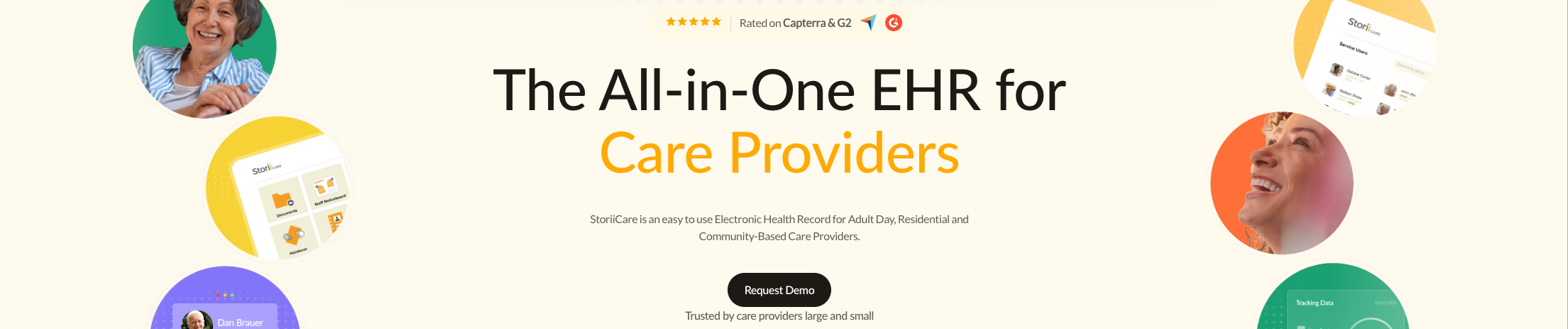
StoriiCare makes electronic health record software for adult day centres, care homes and assisted living operators. Looks like a good product, real customers, and a homepage that tells you what it is in the first sentence. That’s more than most of this category manages.
It’s also a homepage that could belong to any of its competitors.
And that’s the teardown. What makes it worth writing up is what’s sitting one click behind it.
Where this company came from
Start with the About page, because that’s where the good stuff is.
The founder watched a man named Peter lie quiet in a hospital bed until his granddaughter arrived with the family photo albums. He talked to her, to the staff, to the room. Then she left with the albums and he went quiet again.
Somebody saw that happen and decided to make it happen on purpose.
The first product, Storii, recorded life stories using a phone and creating a digital archive. Then the people using it said what they really needed was care management software, and the company built one. That’s the right call. You follow the buyer.
Here’s how the About page tells that story today. The initial focus was social inclusion and reminiscence, then it became clear there was a broader need for something to support a wider range of care operations, and it evolved into a comprehensive EHR platform.
Their story went from creating a unique, one-of-a-kind, personalized profile of a senior to improve their mental, emotional, and physical well-being to a generic, sounds-like-everyone-else health record that captures everything and nothing.
What the homepage says
All-in-one. User-friendly. Comprehensive. Top software choice for care businesses in 12 countries. A mission to revolutionize care management with innovative, user-friendly technology.
Every EHR in senior care has an almost identical version of all of that. It’s the category’s house dressing, and it’s what your buyers see in their eight other open tabs.
On the Hierarchy, that’s Levels 1 and 2. Function and trust. What the product does, and why it’s safe to buy. Both levels matter and every buyer needs them answered. They’re also the two levels where everybody sounds identical, which means nothing there will win you a deal.
The word “reminiscence” – the pièce de résistance – doesn’t appear on the homepage. “Life story” appears once, as a footer link.
The grey bars
There’s a block on the homepage about how easy the software is to use, with a mockup of the interface beside it. Inside the mockup, a resident profile with a face, a name, “Dan Brauer,” “68 years old,” and two grey placeholder bars where the rest of his record would go.
Think about what could be in those bars.
Every EHR in senior care collects the same things. Vitals, medications, ADLs, care plans, incident reports, progress notes. That’s the price of entry, and a buyer comparing three vendors sees the identical list three times.
StoriiCare collects something else. Their own copy says each service user has a personalized profile with life stories and family input, so staff can deliver person-centred care.
So show that. Show me Dan sold industrial solvents for 35 years. That he’s more charming in the morning than the afternoon. That he’ll talk about the Jays for an hour and shuts down if you interrupt him. That his daughter comes by before dinner on Sundays.
A new care aide on her first shift with Dan can read his vitals, or she can know him. One of those makes her better at her job in minutes. That’s the product difference, and nobody else in this category can compete with it.
The page that has the answer
StoriiCare has a page on reminiscence therapy with eight impressive and respected outbound links. The Alzheimer’s Society. NICE. Exeter. York. A study published in a Wiley journal. Every one of them leads to a real source.
Research showing that life story work improves care outcomes.
That research is the “So What?” for the entire homepage. It’s the evidence base for the argument that this EHR produces better care than the one beside it. Storii, their life story product, enhances every resident profile in StoriiCare with life stories and family input. Storii is what makes StoriiCare more effective.
Yet all of that sits on a page nobody will land on, doing nothing.
It’s also the only page on the site where the writing has a point of view. It makes an argument, with evidence, to a reader who might disagree. The homepage makes a list of things everyone else does.
What I’d do
Move the origin story to the front, and not as a sentimental founder’s note. As a product claim.
Every other EHR was built from the clinical record outward, including the ones that say they start with the patient. Vitals, medications, incidents, compliance, then something for families bolted on at the end. Where’s the person in that? StoriiCare came at it from the other direction. They spent years learning who a resident was and what mattered to them before they ever recorded a blood pressure reading.
That’s arguable, which is why it’s worth saying. A compliance-led competitor would fight them on it. Let them. They’d be arguing for starting with the chart.
Then I’d bring the research up from the therapy page and put it behind the claim. Then rebuild that resident profile mockup so it shows a person instead of two grey bars.
None of this is new positioning work. The words are there, just on the wrong pages.
The pattern
This is what I find on nearly every B2B homepage I audit. Almost nobody is missing their position. It’s usually on an About page, a research page, or in a customer video, captured years ago by somebody who knew exactly what they meant, waiting for someone to move it to the front. Or it was at the front once, before the product and portfolio and board folks buried it under all the new bright shiny things.
Run the “So What?” test on your own site this week. Read every claim out loud and ask “so what?” after it. The sentences that end in nothing usually have an answer somewhere else on your domain.
Nobody buys the feature. They buy what happens after it.